
The manifesto of Goldie the Grey sparks urgent discussions across Whitehall and the Crown Estate, challenging established property laws and directly confronting authorities in Cardiff Bay.

This narrative is a fictional creation, intricately woven around real locations and familial research. Evidence tags highlight specific genealogical elements; they do not validate the fictional events, official responses, or legal claims presented.
How is the Civil Service Responding to a Major Challenge?
As the London boardroom cleared, the documents left by Goldie began their rapid journey through the system.
Scanned copies circulated via email. Phone calls interrupted scheduled meetings. An urgent briefing reached the Cabinet Office even before the morning tea had cooled.
Gathered around a conference table, senior policy advisers examined a declaration that defied their usual classifications.
This was not a consultation response or a typical claim to a specific piece of land.
It challenged the very assumptions that underpinned their paperwork.
Alongside it was the family pedigree, tracing an unbroken lineage back thirty-five generations to Rhodri Mawr. Genealogies
This distinction was critical.
The pedigree signified descent, yet Goldie’s declaration aimed to shift that descent into a broader discussion about stewardship, public consent, and the exercise of authority.
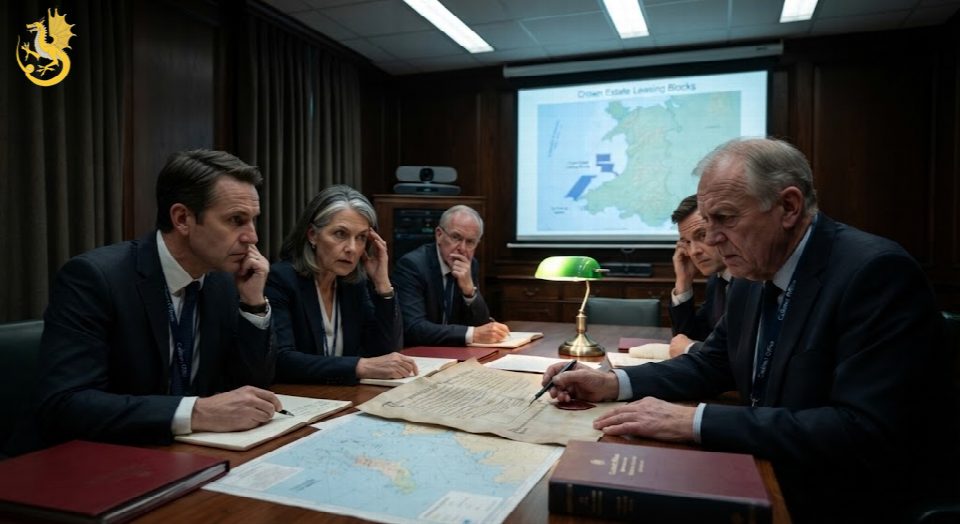
One adviser lowered the document, reflecting on its implications.
“What does he expect us to do?”
“Acknowledge the declaration,” another adviser replied.
“On what basis?”
“That is exactly the challenge we are facing.”
The legal advisers found no basis to accept Goldie’s assertion simply because it was presented with conviction.
The communications team highlighted a different concern.
Images of the parchment had already begun circulating beyond the initial recipients. Excerpts from the declaration appeared in community groups, accompanied by tales of the cloaked figure who had entered a London meeting demanding accountability.
Ignoring him might prevent the claim from gaining an official platform.
It could also allow his narrative to dominate the conversation.
By midday, the focus had shifted.
It was no longer merely about whether Goldie had made a compelling legal case.
The pressing question became how far his message might spread before anyone took action.
What is the Crown Estate’s Stance on Goldie’s Claims?

In a separate briefing with representatives from the Crown Estate, discussions turned to the holdings and activities outlined in Goldie’s dossier.
Maps were spread out alongside financial forecasts.
Coastal sites, offshore developments, and potential leases were evaluated against sections of Goldie’s declaration.
No one suggested that a wax seal had magically altered ownership.
A campaign did not need to secure a legal victory to disrupt a project.
A portfolio manager pointed to the development timeline.
“If this evolves into a coordinated campaign, we must understand the practical implications.”
“What kind of objections could arise?” someone asked.
“Objections, access disputes, public meetings, pressure from partners, inquiries from investors.”
The legal adviser turned a page.
“These issues differ from the validity of his claim.”
“Indeed. But they could emerge concurrently.”
Goldie’s declaration viewed the coastline as an inheritance meant to support the communities that neighbour it.
The briefing documents regarded it as a collection of interests, responsibilities, and commercial agreements.
Neither perspective vanished simply because the other existed.
This was the uncomfortable reality his intrusion had exposed.
An executive read aloud from the declaration.
“‘Who benefits, who decides, and who bears the cost?’”
She placed the document on the table.
“We should be ready to address that publicly.”
For the first time that morning, no one instinctively sought a legal response.
What Knowledge Gaps Exist in Cartography?
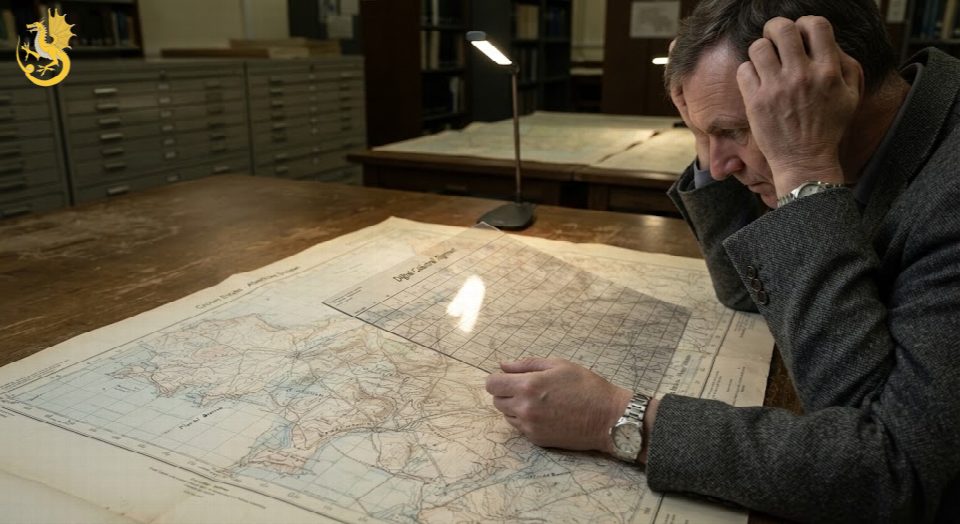
Meanwhile, researchers began to scrutinise the maps included in Goldie’s dossier.
They analysed modern survey extracts, historical estate plans, and annotations from family records.
Some boundaries appeared consistent across various documents, while others shifted, vanished, or emerged under different titles.
A researcher placed a tracing over a nineteenth-century plan.
“The path is indicated here,” she noted.
Her colleague checked a later map.
“It’s not present in this edition.”
“That does not confirm its disappearance.”
“Nor does its existence on the earlier sheet clarify its current status.”
They continued their work in silence for a moment.
Goldie’s declaration treated the maps as witnesses to a landscape gradually enclosed by bureaucratic decisions. The researchers approached them with caution.
Who commissioned each survey?
What was its intended purpose?
Which markings represented physical features, and which were meant to denote rights or boundaries?
The age of the paper alone could not provide the answers.
Older evidence could not be dismissed simply because a newer map appeared more accurate.
In the margin of one document, Goldie had inscribed a thought in dark ink:
A boundary can be measured without its history being understood.
The researcher copied it into her notes.
It was not conclusive proof of his claim.
Yet it raised a valuable question to consider for the next map.
How Does Tension Escalate in Cardiff Bay?
In Cardiff Bay, initial briefings arrived before Goldie’s physical presence was felt.
Officials reviewed summaries of the encounter in London and deliberated whether it necessitated an immediate response.
Some regarded it as a matter for others to resolve.
Others recognised that Goldie’s inquiries regarding Welsh land and coastal revenues would not remain confined to a London boardroom.
For Goldie, the limitations of devolution were part of his grievance. He believed discussions around budgets and administration often overshadowed the fundamental question of who should control the nation’s resources.
Those within the institutions perceived their responsibilities differently.
They had services to fund, legislation to scrutinise, and decisions that could not await a definitive resolution of every constitutional debate.
The gap between these perspectives seemed manageable while Goldie was just a name in a briefing.
The next afternoon, he unexpectedly appeared at the Senedd.
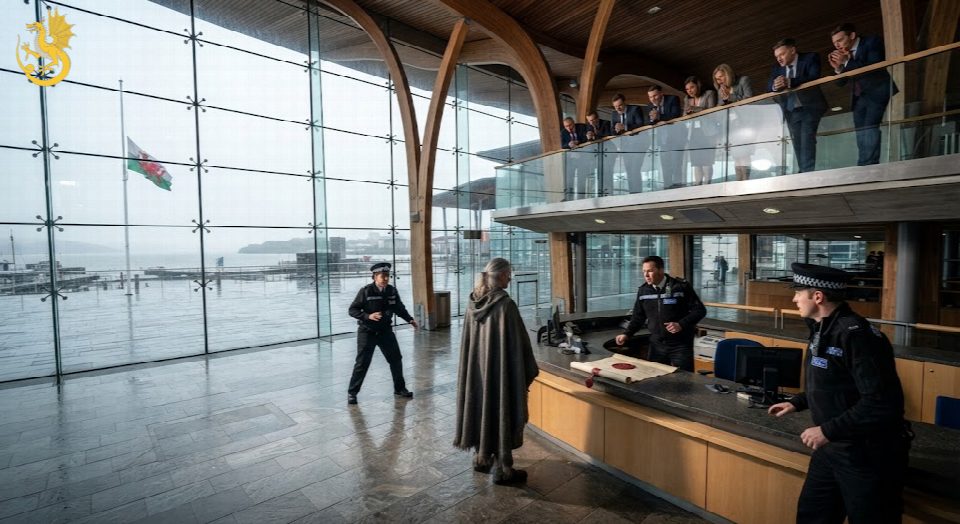
He arrived without a megaphone.
No chanting crowd accompanied him.
He made no prior appointment.
Goldie the Grey approached the public entrance cloaked in his heavy, weathered garment, carrying a fresh parchment.
At the entrance desk, a staff member looked up.
“Can I assist you?”
“I have a document intended for the parliamentary authorities.”
He placed it on the desk.
The wax seal glimmered in the light.
Across the top, in meticulously inked letters, were the words Notice of Reversion.
This was Goldie’s description of the document. Whether anyone accepting it would agree with that terminology was another matter.
“Who is it from?” the staff member asked.
“Goldie the Grey. The House of Rhodri.”
A second staff member approached, intrigued.
Goldie kept his hands visible.
“You manage budgets,” he declared, his voice resonating through the entrance hall. “Yet the people must possess a genuine voice in determining the future of the land.”
He glanced towards the interior of the building.
“A government holding borrowed keys ought to remember whose doors they are unlocking.”
Someone requested that he wait.
He nodded but did not move towards the chamber.
“I have delivered what I intended to deliver.”
With that, he turned and stepped back into the Welsh rain.
For several moments, the parchment lay untouched.
A supervisor was summoned. Someone began documenting the incident. An adviser requested a photograph of the document.
By the time the seal was examined, Goldie had vanished from sight.
Cardiff Bay was no longer merely reading about someone else’s encounter.
It had become a vital part of the unfolding narrative.
What Legal Responses Are Emerging Amidst Clarity Challenges?
By late afternoon, legal advisers in London were reviewing accounts of the delivery at the Senedd alongside the original declaration.
The conversation was more measured than the earlier rushed discussions.
A senior barrister positioned the two documents side by side.
“We need to address the claim he has actually made,” she asserted. “Not a distorted or overly simplified version that is easier to dismiss.”
An adviser opened a folder containing references to the Crown Estate Act 1961 and other legal documents.
“Does the pedigree alter anything?”
“Not on its own. We must differentiate descent from any specific right he asserts follows from it.”
“And what about the notice?”
“Labeling something a notice of reversion does not validate the reversion it claims.”
A junior policy adviser lifted his gaze from the transcript of Goldie’s speech.
“He may not anticipate our acceptance of it.”
The barrister paused.
“Consider the pattern. He presents the document, makes a brief statement, and departs. Then everyone else spends the next day deliberating it.”
“That does not bolster his legal position.”
“No. But it might enhance his public stance.”
The room fell silent.
The challenge was not that the law had been overshadowed by a piece of parchment.
It was that the legal response and the political response did not necessarily align.
A simple rejection might clarify what the institutions were prepared to acknowledge. It would not, however, resolve questions regarding local influence, public benefit, or trust.
The senior barrister closed her notebook.
“Then we should be precise,” she advised. “Clarify what the documents do not prove. Do not pretend that answers every concern raised by those reviewing them.”
Outside the room, a telephone rang once more.
Another copy of the Senedd photograph had reached the press team.
How is a Groundswell of Change Shaping the Valleys?

Far from the briefing rooms, the declaration was finding its own audience.
In pubs, village halls, and mining heritage centres, printed copies were shared among those unaware of the discussions in London.
Some readers absorbed every word.
Others paused at a sentence that seemed to articulate something they had struggled to express.
A farmer underlined a passage about stewardship.
A former trade union organiser noted the questions regarding who profited from development.
A young technician circulated the image of the seal and inquired where the complete document could be accessed.
Not everyone was convinced.
“What relevance does his family tree have to our village?” someone questioned during a gathering.
“Nothing, if he believes it grants him authority over us,” was the retort.
“And if he’s questioning who gets a say?”
“Then we can address that without conceding to everything else.”
The discussions were messy, sceptical, and vibrant.
People expressed concerns about housing, access, energy projects, and decisions made far beyond their communities. Goldie’s declaration did not provide solutions to these issues.
It offered them a shared concept.
Stewardship.
For some, it meant protecting a familiar path. For others, it signified a fairer distribution of the benefits derived from the surrounding land and sea.
For Goldie, it carried the weight of ancestry.
For many engaging with his words, it began with the places they called home.
As rain lashed the slate roofs of Wales, copies continued to circulate from hand to hand and screen to screen.
Whitehall might prepare a response.
Cardiff Bay could decide how to handle the parchment.
But neither could anticipate what each reader would take from it.
The golden dragon had transformed from a symbol of a solitary bard.
It was evolving into a narrative that others could embrace.
Peace, Prosperity, Patience & Justice Under God.
Clarifying Fact and Fiction in the Narrative
Goldie’s intervention in London, the official briefings, the delivery at the Senedd, the researchers, and the community discussions are all fictional. Dialogue is crafted and does not reflect statements by actual officials, employees, or officeholders.
This episode uses real locations, institutions, and legislation as the backdrop for a fictional political conflict. It does not depict an actual security incident or official response.
The genealogical label denotes a connection recorded in the family pedigree. It does not independently verify every generation, establish continuous occupation, or demonstrate contemporary ownership or sovereignty.
Maps, family records, and historical references form part of the disputed evidence within the story. Their inclusion does not substantiate the legal conclusions Goldie draws from them.
Goldie’s interpretation of Lex Terrae is a fictional moral and political discourse, not a declaration of established legal rights. Presenting a declaration or rejecting an institution’s authority does not, on its own, negate existing law or title.
No Documented label is applied to the fictional events or legal arguments.
Continue the Story
The post Shockwaves in Whitehall: Uncovering Episode 2 appeared first on Limits Of Strategy.