Explore the rich tapestry of Welsh heritage, the iconic golden dragon emblem, and an inspiring vision for Wales, which encompasses five kingdoms, fifteen castles, and a modern charter influenced by the Laws of Hywel Dda.

Unifying Five Kingdoms: The Golden Dragon as Our Guiding Symbol
Greetings, I am Goldie The Grey.
The value of gold deserves a thorough exploration, while the essence of grey is more apparent.
What story does the golden dragon tell?
This symbol carries a profound narrative. So, pour yourself a drink—whether it’s tea, coffee, or something stronger, as you prefer. Take a moment to relax and engage with the visions I share through storytelling.
Beginning the Journey of Discovery
You might think my story starts with a legendary sword, a prophetic tale, or the arrival of a mysterious figure on a fateful night.
In reality, it starts with the task of digitising Mam’s paperwork to preserve it for future generations.
This endeavour may seem overwhelming at first.
Family paperwork often becomes more than just documents. A name transforms into a question mark. A branch of the family tree evolves into a journey of discovery. Before long, you find yourself contemplating your family tree, questioning how much of your identity you understood before embarking on this quest.
As I navigated this path, the narrative grew beyond merely protecting Mam’s documents.
Unraveling the Names That Connect Us
Within the lineage I am tracing, I find myself thirty-five generations removed from Rhodri Mawr.
This connection deepens my understanding of my ancestry. Tracking these generations is essential, as a family tree signifies more than a mere line connecting a monarch to a contemporary individual.
There are stories behind each name.
Each person had their own household to uphold, children to raise, losses to endure, and decisions to face.
These stories deserve more than to be hastily glossed over in pursuit of an impressive lineage.
I yearn to learn about them as well.
I strive to create space for the family tales that do not fit neatly into a chart.
For the House of Rhodri, as I have come to see it, is a remarkable lineage.
Exploring the Multitude of Identities in Our Family
Witches, mages, shamans, seers, healers, empaths, and mystics.
These terms represent just a fraction of the mystical lives and experiences that colour my family’s history.
Not every descendant might choose the same descriptors. Each generation interprets these concepts in its own unique way.
I do not suggest that every ancestor documented their unique talents.
Mam had more than enough paperwork already.
These elements form part of the language through which I comprehend our family: love, intuition, mystical practices, inspiration, care, and experiences that often require more time to express than to feel.
I can share these narratives without expecting everyone to interpret them as I do.
They hold intrinsic value simply by existing.
Developing My Personal Understanding
As for my own experiences, I describe some as shamanic and others as mage-like. Inferred
These terms resonate most closely with my intended meaning.
The experiences behind these labels will require their own narrative. I do not wish to obscure them in borrowed mystique or imply that I have simplified them merely by assigning mystical terms.
There is room for belief.
There is also space for inquiry.
In sharing this narrative, I aim to distinguish between my memories, family stories, documented facts, and insights gained through my own mystical journey.
The golden dragon can possess deep meaning without having to serve as proof of everything.
Claiming My Kingdom: A Personal Journey
Before anyone gets too excited:
I am not claiming a throne.
I am claiming a kingdom.
The heavenly kingdom of Wales serves as the name I give to the mystical landscape of this narrative: a tapestry of ancestry, imagination, belonging, and a vision of what can still be realised.
As Above, So Below.
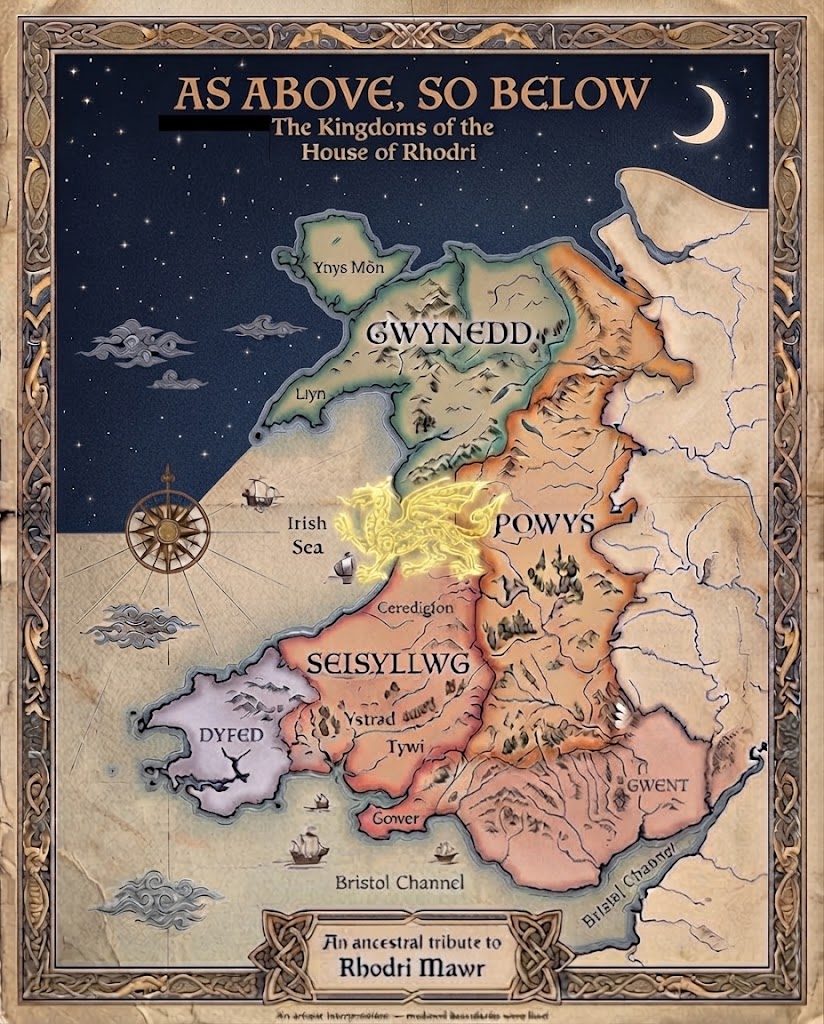
On the map, that vision begins to take shape.
Gwynedd.
Powys.
Seisyllwg.
Then Dyfed and Gwent.
Five Names, Five Colours: Envisioning a Unified Wales
The map emerged from an interest in Rhodri’s domain, but the narrative did not remain confined to the past.
The family story extends far beyond the initial three coloured regions. As it grew, so did the vision.
This is the distinction I wish to clarify:
We are not merely rewriting history and pretending it always looked this way.
We are imagining a future.
Our five-kingdom map serves as a proposal expressed through narrative and art. Its boundaries represent the shape of an idea, rather than asserting that every section belonged to a single ruler at a specific historical moment.
The House of Rhodri is the name under which I am assembling this concept.
Identifying the Castles Within Our Vision
Then came the castles.
If we are to discuss five kingdoms, we must pinpoint the places within our vision.
Fifteen castles emerged as our initial landmarks.
These do not encompass all the castles in Wales, nor do they tell the entire story. They are fifteen sites from which we can begin weaving our narrative.
In our Gwynedd, we acknowledge Caernarfon, Conwy, and Harlech.
In our Powys, we recognise Powis, Montgomery, and Dolforwyn.
In our Seisyllwg, we highlight Cardigan, Dinefwr, and Carreg Cennen.
In our Dyfed, we name Pembroke, Carew, and Manorbier.
And in our broader Gwent, we mention Caerphilly, Cardiff, and Chepstow.
There they stand.
Fifteen Castles Shaping Five Kingdoms into a Shared Vision
In the narrative of the House of Rhodri, each castle lies beneath the golden dragon.
This is their role in the story; not by claiming they were all built by our ancestors or that their histories began with us. Each castle has its own rich history, and this assertion does not alter its current ownership or stewardship.
We are envisioning how these sites might belong to a collective future.
Some may enter our family story through memories, while others might connect through undiscovered links. Some could be spaces where we pause, reflect, and contemplate the future we envision for Wales.
Identifying them makes the vision feel more concrete.
You might say “five kingdoms” and leave others to imagine nearly anything.
But mention Caernarfon, Dinefwr, or Pembroke.
Suddenly, there are destinations to explore, questions to ask, and stories to reveal.
The map begins to feel like a journey waiting to be undertaken.
Which is all well and good.
Before anyone wonders where I plan to hide the keys to these fifteen castles (that’s a secret!), let me remind you that this all started with the need to find a digital home for Mam’s paperwork.
We are tackling one responsibility at a time.
The Flag Symbolising Our Vision
Next, we designed a flag to represent our vision.
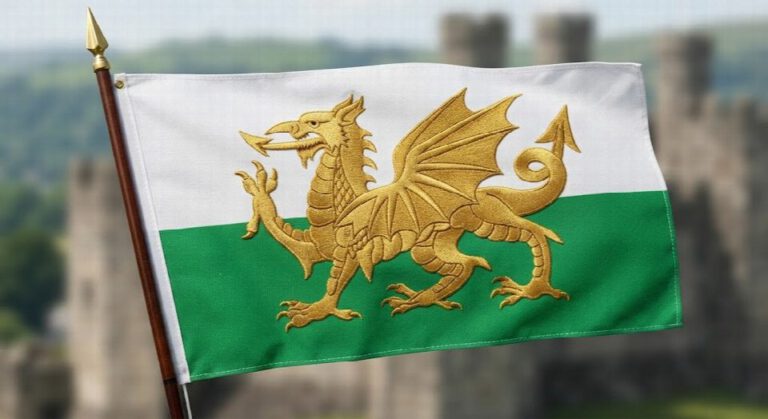
For this envisioned flag, we retained the white above and green below, placing a golden dragon at the centre, where the red dragon traditionally resides. The red dragon embodies raw emotion, will, fire, and ash. In its place, we envision purpose, love, and courage.
The white represents the heavens.
The green symbolises the earth.
The golden dragon expresses our aspirations for Wales’ prosperity within the framework of the House of Rhodri.
To me, these colours convey the belief that God created both the heavens and the earth. They unite the mystical with the earthly in a singular image.
As Above, So Below.
And beneath this image lie our guiding principles:
<em>Peace, Prosperity, Patience & Justice Under God.</em>
-
Peace – not a demand for uniformity, but a commitment to cultivate understanding without coercion.
-
Prosperity – not wealth concentrated in a few hands, but the flourishing of individuals, communities, culture, and land.
-
Patience – because a future worth building cannot be conjured into existence simply by declaration.
-
Justice – as none of the other promises hold weight if individuals cannot expect fair treatment.
“Under God” expresses my unwavering faith and the sense of responsibility that accompanies it. It is not necessary for everyone to share my beliefs.
No one should be compelled to adopt a religion, accept a mystical claim, or acknowledge the sacredness of the dragon to enjoy equal dignity.
I would raise this flag as an invitation to contemplate a vision.
Not as a means to silence another’s voice.
Upholding Values in the Kingdoms
A map provides an excellent foundation.
Yet, it is insufficient for governance.
Eventually, someone will justifiably ask about the practical implications.
What does this mean for the people inhabiting these lands?
This is a valid concern.
A golden dragon is striking, yet it cannot resolve grievances merely by shining more brightly.
The narrative requires a charter.
I do not advocate for the current governmental structure as the future I envision for Wales. Yet, discontent, no matter how intense, marks only the beginning of a conversation.
If I am to champion an alternative future, I must be prepared to articulate it.
This includes not only identifying who would be central to the map.
How power would be constrained.
How the voices of the people would be amplified.
How one could disagree with the House of Rhodri while remaining equally free, safe, and Welsh as anyone else.
A Modern Charter for Progress
As a basis for this vision, we have chosen to draw inspiration from Cyfraith Hywel … the Laws of Hywel Dda.
This is not about a literal revival of every medieval regulation.
Rather, it involves a contemporary charter rooted in that heritage, carefully examined and crafted for the people who would live under it today.
This is the proposal we are beginning to articulate.
No longer the Laws of the Sea; we demand the Laws of the Land …
Equal dignity.
Freedom of conscience.
Freedom of speech.
Leadership accountable for its decisions.
Justice that aims to repair harm when possible while protecting those who have suffered.
Stewardship of the land, water, minerals, language, traditions, and places entrusted to us.
A meaningful voice for individuals across all five kingdoms.
These are commitments we must uphold in practice, not mere phrases to embellish an attractive image.
The charter must accommodate people whose beliefs differ from mine.
There must be space for the mystic and the sceptic, for the religious and the agnostic, for those who find significance in the dragon and those who appreciate the artistry.
No one should need to share my mystical insights to possess equal rights.
Ensuring Justice Within the Castles
In this envisioned future, the castles would serve purposes beyond their geographical locations.
We see them as homes for courts: venues where justice resonates within the communities they serve.
This would not be the current judicial framework draped in a new flag, but an alternative proposal whose authority rises from an agreed charter and laws openly established with the consent of the populace.
We intend for all courts to convene in castle settings, where conservation, safety, and accessibility can align with that purpose. If a site cannot accommodate a functional court, suitable facilities must be considered without compromising the integrity of the location we aim to honour.
Because a symbol holds no value for justice if individuals cannot enter.
Judgment would be entrusted to the community; members of society under the new laws we propose.
“the community” must never be synonymous with the loudest voices within it.
A person should not lose a case due to unpopularity, unfamiliarity, poverty, or difference.
Knowing someone’s reputation must not be confused with understanding the evidence.
The charter should thus include clear safeguards: impartial selection, the removal of anyone with conflicts of interest, independent legal counsel, and a fair opportunity for each party to be heard.
Anyone accused would be presumed innocent unless the evidence meets the legal standard. They would have the right to comprehend the allegations, receive legal support, contest the evidence, and seek an independent appeal.
Those who report harm deserve safety, dignity, and support throughout the process.
Decisions must be justified.
The laws should be public, understandable, and subject to challenge and revision through agreed procedures.
And no individual—not a leader, not a relative, not the visionary behind this concept—shall have the authority to dictate a verdict.
Including myself.
Especially if I happen to be standing beneath an especially imposing dragon at the time.
Where harm can be rectified, the court should seek meaningful restoration. Where protection is needed, it must be provided. Forgiveness may be freely offered but must never be demanded from those who have been harmed.
This is the justice I envision for these castle courts.
Not spectacle.
Not retribution.
Responsibility, equity, and a path forward.
These are proposals for a potential future, not courts we can manifest into lawful existence merely by declaring them. Until any changes are lawfully instituted, the vision will not replace existing courts or absolve anyone of their current legal responsibilities.
The Importance of a House
When I refer to a “House,” I intend for it to embody a sense of responsibility.
My ancestry may illuminate why I embarked on this journey. It does not render me more valuable than those alongside me.
It does not place me above the law.
Nor can it, in isolation, grant me authority over individuals who have not consented to it.
Any future political arrangement must secure the freely expressed consent of the people, achieved through peaceful and lawful transformation.
Otherwise, we would have sketched five kingdoms without addressing the most crucial question:
Whose home are we discussing?
Wales is already inhabited by individuals with their own lives, beliefs, aspirations, and disagreements.
A meaningful vision must encompass them.
The House, as I envision it, must be capable of listening as well as speaking.
And if its proposals cannot withstand critical examination, then those proposals require further development.
Awakening the Vision
When I say the Golden Dragon of Wales is awake, I am referring to the awakening at the heart of this narrative.
My growing awareness of family.
My quest for a language to articulate mystical experiences.
My desire to envision a Wales centred around belonging, responsibility, and justice.
The dragon serves as the symbol I have chosen to encapsulate these ideals.
Its awakening does not prove that I possess all the answers.
It signals the beginning of exploring what I intend to do with these inquiries.
What does my ancestry demand of me?
What does my faith require in how I treat someone who does not share it?
What changes would I be willing to consider in my own vision after listening to another perspective?
These questions belong beneath the flag just as much as any declaration.
The Current Landscape of the Narrative
This is where we currently find ourselves.
A lineage being traced.
My mother’s research.
My own efforts to articulate experiences that hold meaning for me.
Five kingdoms represented on a map.
Fifteen castles identified within the vision.
A proposed flag of white, green, and gold.
And the inception of a charter: a framework for discussion, testing, questioning, and improvement.
There remains much that I do not know.
This is not a reason to fabricate the missing pieces.
It is a reason to continue searching.
They call me Goldie The Grey.
The gold needs clarification.
The grey is self-explanatory.
If you came expecting a demand for a throne, you may need to settle for a family narrative, a proposed charter, and a rather ambitious map.
All of which originated from the need to find a digital home for my mother’s research.
Peace, Prosperity, Patience & Justice Under God.
As Above, So Below.
The Golden Dragon of Wales is Awake – Book 1
A fictional series following Goldie the Grey, the golden dragon, and a vision for Wales. Read the episodes in sequence:
The post The Golden Dragon of Wales Has Awoken appeared first on Limits Of Strategy.