
The actions taken by Goldie the Grey instigate a considerable disruption within the Senedd, resulting in legislative gridlock in Cardiff Bay. This prompts Whitehall to employ stringent containment strategies, while universities and valley communities unite around ancient land rights and the notion of Lex Terrae.

This narrative is a fictional piece, intricately woven around real locations and extensive family genealogical research. Evidence tags highlight specific genealogical elements; they do not validate the fictional events, official responses, or legal arguments presented.
Episode 3: Exploring the Senedd Disruption and the Map of Resistance
Rain lashed against Cardiff Bay, striking the glass façade of the Senedd building and distorting the reflections on the wet pavement below.
Inside, beneath the grand timber ceiling, the machinery of Wales’ devolved governance was struggling to regain its usual morning rhythm.
The events of the previous afternoon loomed heavily over the day’s proceedings.
The wax-sealed parchment left by Goldie the Grey at the security desk had not been quietly filed away or discarded into a confidential waste bin.
Instead, it had been photographed, encrypted, and rapidly circulated among senior ministers, committee chairs, and legal advisors before the evening news settled on a narrative.
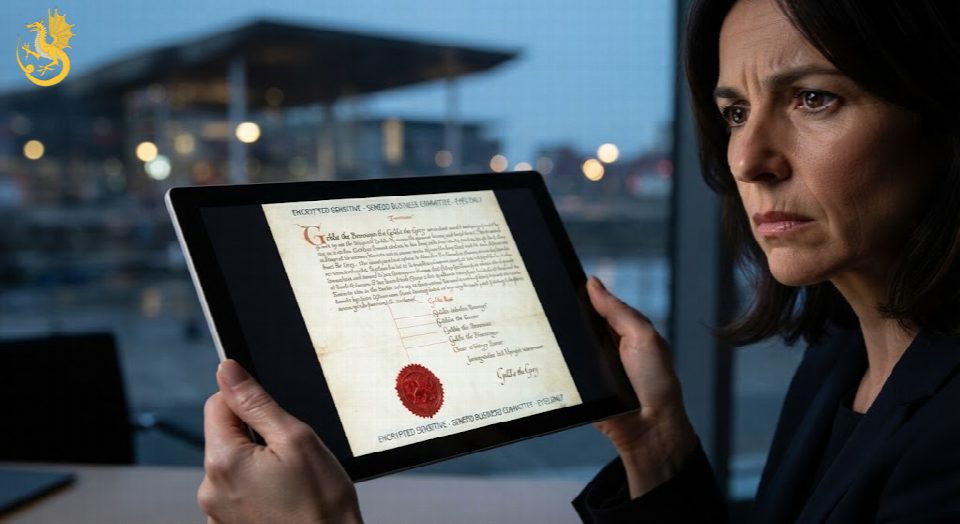
For over twenty-five years, the structures of devolved government had functioned within a constitutional framework that Goldie now openly contested.
Politicians had built their careers around managing budgets, healthcare waiting lists, agricultural policies, and transport initiatives. Despite their differences, the mechanisms for debate had remained consistent.
Goldie’s intervention dismissed those familiar conventions.
He did not submit a petition or request a meeting. Instead, he delivered what he termed a notice of reversion, asserting an ancestral authority that the institution neither recognised nor knew how to address.
Ministers examined digital scans of the family pedigree alongside transcripts of his carefully articulated words in the atrium.
The pedigree traced a lineage spanning thirty-five generations back to Rhodri Mawr. Genealogies
Goldie intricately wove that heritage into a broader assertion about stewardship, sovereignty, and land ownership.
To his supporters, the message was unmistakable: those holding borrowed keys could no longer presume to control the doors.
Addressing Legislative Gridlock in Cardiff Bay
The parliamentary agenda for the day was the first casualty of the manifesto.
By ten o’clock, an emergency meeting convened, drawing together senior parliamentary figures, party representatives, and legal advisors.
Whips, accustomed to enforcing discipline over budgets and amendments, now faced a challenge that defied the conventional terms of debate.
At the head of the table, the chair called for order, and conversations dwindled into an uneasy silence.

“We are facing an unprecedented disruption,” the chair began.
“Legal services are currently reviewing the document. We must separate its legal standing from its political ramifications.”
A senior member leaned forward.
“Treat this as a publicity stunt. Engaging with his claim on his terms grants him exactly what he seeks.”
A legal adviser closed the folder in front of him.
“Ignoring the claim does not resolve the security breach,” he replied. “Nor does it explain why copies are already in circulation across the nation.”
“He left a piece of paper on a desk,” another member interjected.
“He entered this building, delivered his message, and departed. By last night, discussions were centred around his narrative instead of ours.”
The room fell into silence.
The adviser continued.
“We do not concede his argument by responding. If our reply consists solely of locked doors and silence, he will weave that into the next chapter.”
Outside the meeting room, the routine operations of government continued. Staff moved through the corridors with briefing documents. Phones rang incessantly. Meetings were postponed without explanation.
The building remained open.
Its confidence, however, was another matter.
Westminster’s Strategy: The Cabinet Office Takes Charge

As Cardiff Bay wrestled with its response, Whitehall shifted towards a strategy of containment.
Emergency briefings following Goldie’s London boardroom appearance had already involved several departments. His visit to the Senedd heightened the urgency of those discussions.
A secure video conference brought together senior officials and legal advisors, focusing on the Crown Estate, justice, and Welsh affairs.
Their screens displayed reports of the manifesto gaining traction through community networks, trade union halls, and historical societies across Wales.
An argument built from family trees, ancient charters, and customary claims was spreading at the speed of fibre optics.
“We cannot dismiss this as a mere local nuisance,” the senior official leading the meeting insisted.
“The immediate risk is not that a lineage will overturn registered title. It is that enough individuals may begin to believe it can and act upon that belief.”
One of the legal advisors nodded in agreement.
“The statutory framework remains intact. His notice does not suspend it.”
“Then we must publicly clarify that.”
“We can do that. Whether anyone pays attention is an entirely different matter.”
Another official presented a map of coastal holdings and proposed energy developments.
“If the campaign convinces communities that every lease equals dispossession, we may encounter objections, disrupted access, and prolonged disputes. Investors need not subscribe to his legal argument to feel anxious about the repercussions.”
The proposed response was methodical and intentionally low-key.
Lawyers would assess the holdings mentioned in the dossier. Officials would review applications linked to participating community groups. Police liaison teams would be briefed on Goldie’s movements and planned events.
On paper, each action could be framed as routine.
Together, they formed a tightening network.
No one mentioned the word retaliation.
No one needed to.
Engaging the Academic and Archival Frontlines
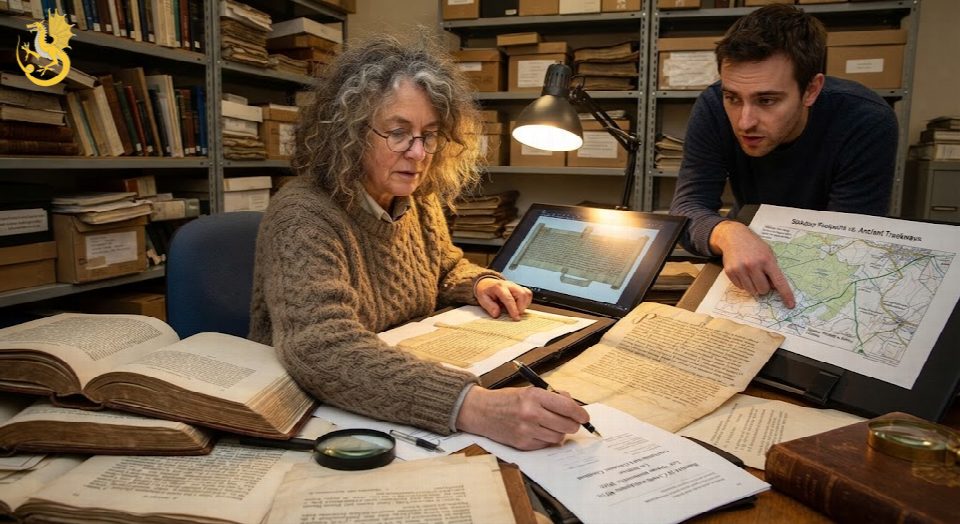
Away from Whitehall’s secure conference rooms, copies of Goldie’s dossier infiltrated university offices and archive reading rooms.
Historians, legal scholars, and researchers began to analyse the materials he had compiled: medieval Welsh legal texts, charter references, family trees, and accounts of customary tenure.
Some viewed it as a provocative misuse of history. Others believed his inquiries warranted a more serious response than the authorities seemed prepared to provide.
At Aberystwyth University, Professor Elinora Vance scrutinised a digital scan of the dossier in her cluttered office.
Surrounding her were editions of medieval charters, collections of monastic records, and copies of parish entries. Until that week, these materials had primarily occupied the meticulous realm of research, where an uncertain date could take an afternoon, and a disputed boundary could sustain an entire thesis.
Now they were being cited in manifestos and government briefings.
A junior researcher appeared in the doorway, carrying maps and a freshly printed legal summary.
“Professor, you need to see this.”
Vance cleared a spot on her desk.
“The lawyers advising against Goldie’s claim are citing the Statute of Rhuddlan and subsequent Tudor legislation,” the researcher informed her. “Their argument is that the older arrangements cannot substantiate the rights he asserts now.”
Vance read the summary in silence.
Then, she removed her spectacles.
“They may succeed in countering his claim,” she said. “That does not mean they have addressed every question he has raised.”
She turned to a transcription of a medieval land grant.
“We need to untangle several elements: descent, occupation, custom, title, and political authority. Goldie intertwines them as if they were a single continuous thread. His adversaries would prefer to sever the thread and dismiss the entire bundle.”
“And do you believe he is correct?”
“I think we should determine what the records genuinely support before anyone declares the matter resolved.”
She glanced again at the map.
“To Goldie, Lex Terrae represents a covenant between people and land. That is the moral weight of his argument. If we are to defend any aspect of it in legal terms, mere conviction will not suffice.”
Outside, rain pattered against the office window.
Vance reached for her fountain pen.
She began drafting a memorandum that delineated the documented material from the disputed interpretations, outlining the strongest argument she believed the evidence could support.
This would soon be shared with Goldie.
Mobilising Community Resistance and Upholding Common Land Stewardship
As researchers examined the dossier, its political ramifications began to take on a life of their own.
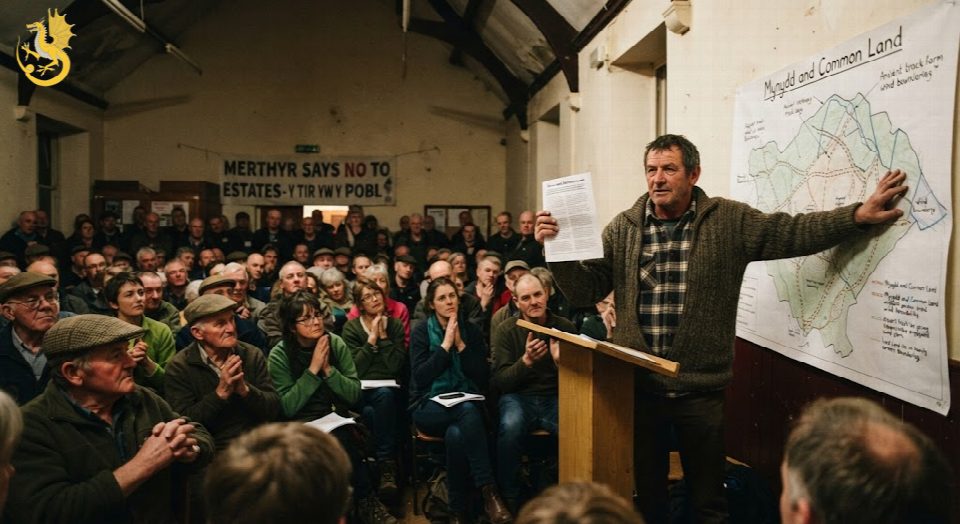
In Merthyr Tydfil, a meeting at a draughty miners’ institute gathered trade unionists, environmental activists, young tech workers, and elderly farmers.
No party banners adorned the platform.
Instead, maps covered the walls: common land, ancient sheep paths, forestry boundaries, and locations where residents claimed familiar access routes had vanished behind new fences.
Some of these locations appeared in Goldie’s dossier. Others were contributed by individuals arriving with their own documents and memories.
Tomos Edwards, a retired surveyor and lifelong valley resident, stood behind a worn wooden lectern.
He waited for the final whispers to fade before unfolding his copy of the manifesto.
“For generations, we have seen decisions made about this land from afar,” he began.
“We hear about investments, developments, and national priorities. Then we wonder what remains here once the contracts are signed.”
A murmur of agreement rippled through the room.
Tomos placed the manifesto beside a local map.
“I am not claiming that a pedigree resolves a boundary dispute. It does not. We will need records, evidence, and individuals willing to examine them thoroughly.”
He tapped the map.
“But Goldie has reminded us to question who makes the decisions, who benefits, and who must bear the consequences.”
Someone from the back called out in affirmation.
“He did not go to London and Cardiff to plead for a favour,” Tomos continued. “He went to assert that stewardship comes with responsibilities that do not end at the edge of a balance sheet.”
He lifted the document, showcasing the seal of the House of Rhodri.
“If we desire a stronger voice in what happens here, we must organise. We document the paths. We scrutinise the boundaries. We attend the meetings. We challenge what can be challenged, and we do so collectively.”
Applause erupted from the back of the hall, reverberating towards the platform.
By the close of the evening, volunteers had committed to gathering records, documenting access issues, and planning further meetings.
Goldie’s manifesto had transformed into more than a text to be read.
It had ignited action.
The Gathering Storm Approaches
In the days that followed, the initial shock in Whitehall and Cardiff Bay solidified into a resolve to contain the movement before it gained further momentum.
Reports circulated through encrypted messages and hurried phone calls.
Unmarked vehicles were spotted near estate entrances. The police had begun inquiring about upcoming gatherings. Lawyers were exploring potential injunctions regarding specific sites.
Some reports were accurate. Others were exaggerated.
For those already convinced that the state feared Goldie’s message, the distinction blurred.
Meanwhile, community organisers replicated maps, booked venues, and excavated boxes of historical records.
In Aberystwyth, Vance continued her memorandum.
Far to the north, evening descended over the mountains above the Conwy Valley.
High on a windswept ridge, Goldie the Grey observed the lights of the valley towns begin to twinkle below him.
He felt no trepidation about the impending legal storm. He understood that the institutions he had challenged would not relinquish their authority without a fight.
The wind tugged at his heavy grey cloak. In one weathered hand, he held a fresh, unsealed parchment.
His notices had been dispatched. Copies of the dossier now circulated beyond his control, reaching individuals he had never encountered.
Some would dismiss them. Some would misinterpret them.
Others would begin to raise their own questions.
The first two phases of his journey were complete: London, then Cardiff Bay.
What lay ahead would require more than an entrance and a declaration.
As rain began to strike the ancient stones beneath his feet, Goldie gazed south into the encroaching darkness.
He would need to proceed with caution now.
Whatever warrant might eventually bear his name, he held one certainty.
It could banish him from the land.
It could not erase the questions.
Peace, Prosperity, Patience & Justice Under God.
Clarifying Fact and Fiction
Goldie’s intervention, the emergency meetings, the official responses, Professor Elinora Vance, the junior researcher, and Tomos Edwards are fictional characters. Dialogue attributed to officials and advisors is invented and does not reflect actual statements made by real officeholders.
This episode utilises authentic locations and institutions as a backdrop for a fictional political conflict. The surveillance, administrative pressures, and legal discussions described are fabricated events, not allegations regarding actual conduct.
The genealogical label denotes a relationship recorded in the family pedigree. It does not independently verify every generation, establish uninterrupted occupation, or prove present-day ownership or sovereignty.
References to historical legislation and legal materials provide context for the fictional debate. The interpretations put forth by the characters, including Goldie’s understanding of Lex Terrae, do not constitute statements of established legal rights.
No Documented label is applied to the fictional events or legal arguments.
The post Senedd Ultimatum: Episode 3 Insights and Revelations appeared first on Limits Of Strategy.