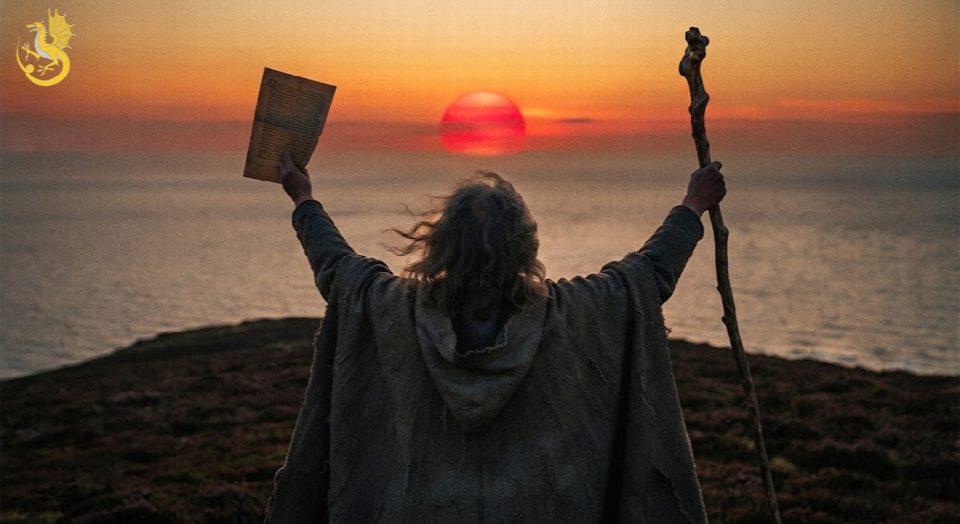
The actions of Goldie the Grey have triggered a profound rift in the Senedd, resulting in legislative paralysis in Cardiff Bay and aggressive containment measures from Whitehall. Universities and valley communities unite around ancient land rights and the principle of Lex Terrae.

This narrative is a work of fiction, intricately based on real locations and family genealogical research. Evidence tags highlight specific genealogical components; they do not authenticate the fictional sequences of events, official reactions, or legal arguments.
Episode 3: Exploring the Senedd Breach and Resistance Mapping
Rain lashed against Cardiff Bay, hammering the glass façade of the Senedd building and distorting the reflections on the slick pavement outside.
Inside, beneath the grand timber ceiling, the machinery of devolved governance in Wales struggled to regain its usual morning momentum.
The events of the previous afternoon cast a long shadow over the proceedings.
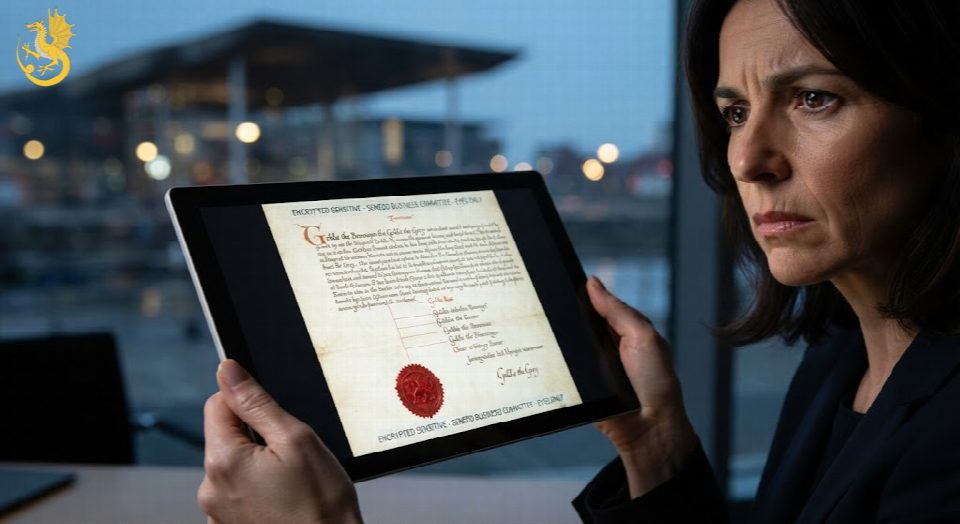
The wax-sealed parchment left by Goldie the Grey at the security desk had not been quietly filed away or discarded into a confidential waste bin.
Instead, it had been photographed, encrypted, and shared with senior ministers, committee chairs, and legal advisers before the evening news could establish its narrative.
For over twenty-five years, the frameworks of devolved government operated within a constitutional structure that Goldie now openly challenged.
Politicians had built their careers around budgets, healthcare waiting lists, agricultural policies, and transport initiatives. Despite their disagreements, the processes through which they debated had remained unchanged.
Goldie’s intervention bypassed those familiar conventions.
He did not submit a petition or request a meeting. Instead, he delivered what he referred to as a notice of reversion, asserting an ancestral authority that the institution neither recognised nor quite knew how to address.
Ministers examined scans of the family pedigree alongside transcripts of his composed statements in the atrium.
The pedigree traced a lineage back thirty-five generations to Rhodri Mawr. Genealogies
Goldie intricately wove that heritage into a broader assertion regarding stewardship, sovereignty, and land ownership.
For his supporters, the message was unmistakable: those who wield borrowed keys could no longer presume to own the doors.
Addressing Legislative Impasse in Cardiff Bay
The first casualty of the manifesto was the parliamentary agenda for the day.
By ten o’clock, an emergency meeting had convened, gathering senior parliamentary figures, party representatives, and legal advisers.
Whips, accustomed to enforcing discipline over budgets and amendments, now wrestled with a challenge that rejected the terms of debate.
At the head of the table, the chair called for order, and discussions dwindled into an uneasy silence.

“We are facing a disruption of an unusual nature,” the chair began.
“Legal services are reviewing the document. We must distinguish its legal standing from its political implications.”
A senior member leaned forward.
“Treat it as a publicity stunt. If we engage with his claim on his terms, we give him exactly what he wants.”
A legal adviser closed the folder in front of him.
“Dismissing the claim does not resolve the security breach,” he countered. “Nor does it explain why copies are already circulating throughout the nation.”
“He left a piece of paper on a desk,” another member interjected.
“He entered this building, delivered his message, and left. By last night, discussions shifted focus to his narrative instead of ours.”
The room fell silent.
The adviser continued.
“We do not concede his argument by responding. If our reply consists solely of locked doors and silence, he will craft that into the next chapter.”
Outside the meeting room, the routine operations of government continued. Staff moved through the corridors with briefing documents. Phones rang insistently. Meetings were postponed without explanation.
The building remained open.
Its confidence, however, was in question.
Westminster’s Strategy: The Cabinet Office Takes Charge

As Cardiff Bay grappled with its response, Whitehall moved towards containment.
Emergency briefings following Goldie’s London boardroom appearance had already involved several departments. His visit to the Senedd heightened the urgency of those discussions.
A secure video conference convened senior officials and legal advisers focused on the Crown Estate, justice, and Welsh affairs.
Their screens displayed reports of the manifesto spreading through community networks, trade union halls, and historical societies across Wales.
An argument rooted in family trees, ancient charters, and customary claims was travelling at the speed of fibre optics.
“We cannot dismiss this as a mere local nuisance,” the senior official leading the meeting asserted.
“The immediate risk is not that a lineage can overturn registered title. It is that enough individuals begin to believe it can and act on that belief.”
One of the legal advisers nodded in agreement.
“The statutory framework remains intact. His notice does not suspend it.”
“Then we must communicate that publicly.”
“We can. Whether anyone pays attention is a different matter.”
Another official presented a map of coastal holdings and proposed energy developments.
“If the campaign convinces communities that every lease equates to dispossession, we may face objections, disrupted access, and prolonged disputes. Investors do not need to subscribe to his legal argument to become concerned about the consequences.”
The proposed response was methodical and intentionally low-key.
Lawyers would assess the holdings mentioned in the dossier. Officials would review applications linked to participating community groups. Police liaison teams would be briefed on Goldie’s movements and planned events.
On paper, each measure could appear routine.
Together, they formed an increasingly tight network.
No one mentioned the term retaliation.
No one needed to.
Engaging the Academic and Archival Battlegrounds
Away from Whitehall’s secure conference rooms, copies of Goldie’s dossier infiltrated university offices and archive reading rooms.
Historians, legal scholars, and researchers began to analyse the materials he had compiled: medieval Welsh legal texts, charter references, family trees, and accounts of customary tenure.
Some viewed it as a provocative misuse of history. Others believed his inquiries warranted a more serious response than those in authority seemed inclined to offer.
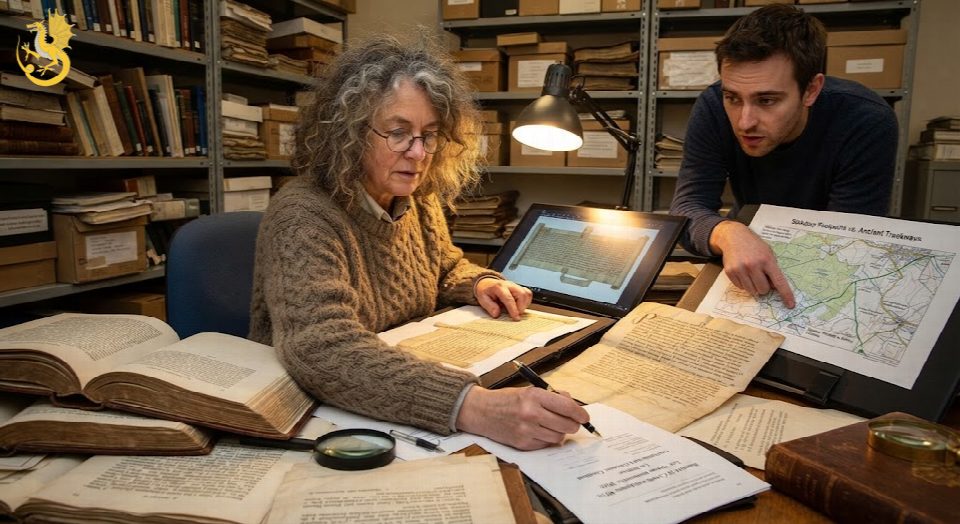
At Aberystwyth University, Professor Elinora Vance scrutinised a digital scan of the dossier in her cluttered office.
Surrounding her were editions of medieval charters, collections of monastic records, and copies of parish entries. Until that week, these materials had primarily belonged to the meticulous realm of research, where an uncertain date could occupy an afternoon, and a disputed boundary could sustain an entire thesis.
Now they were being cited in manifestos and government briefings.
A junior researcher appeared in the doorway, carrying maps and a freshly printed legal summary.
“Professor, you need to see this.”
Vance cleared a space on her desk.
“The lawyers advising against Goldie’s claim rely on the Statute of Rhuddlan and subsequent Tudor legislation,” the researcher informed her. “Their stance is that the older arrangements cannot support the rights he asserts today.”
Vance read the summary in silence.
Then, she removed her spectacles.
“They may succeed in defeating his claim,” she said. “That does not mean they have addressed every question he has raised.”
She turned to a transcription of a medieval land grant.
“We need to disentangle several elements: descent, occupation, custom, title, and political authority. Goldie intertwines them as if they were a single continuous thread. His adversaries would prefer to sever the thread and dismiss the entire bundle.”
“And do you believe he is correct?”
“I think we should ascertain what the records genuinely support before anyone declares the matter resolved.”
She glanced again at the map.
“To Goldie, Lex Terrae represents a covenant between people and land. That is the moral weight of his argument. If we are to defend any aspect of it in legal terms, mere conviction will not suffice.”
Outside, rain pattered against the office window.
Vance reached for her fountain pen.
She began drafting a memorandum that delineated the documented material from the contested interpretations, outlining the strongest argument she believed the evidence could support.
This would soon be shared with Goldie.
Mobilising Community Resistance and Upholding Common Land Stewardship
As researchers delved into the dossier, its political implications began to emerge.
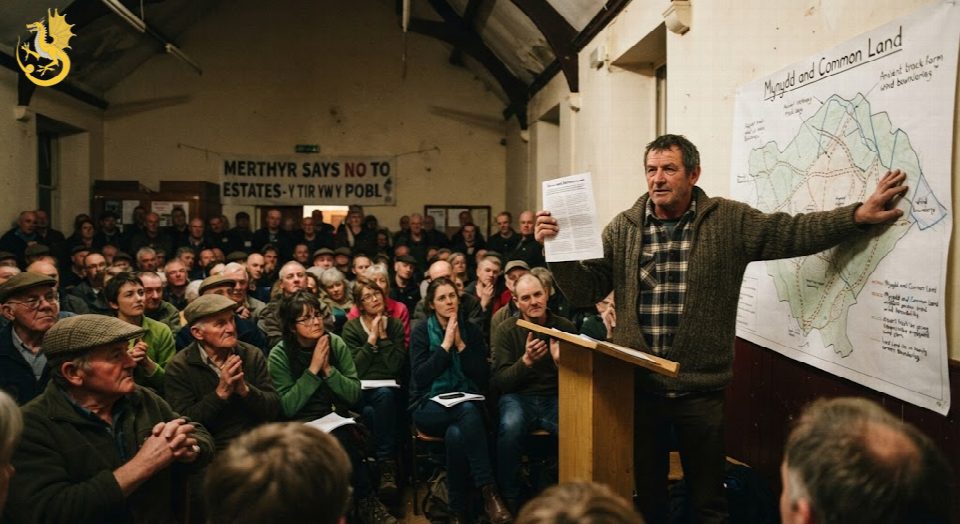
In Merthyr Tydfil, a gathering held at a draughty miners’ institute brought together trade unionists, environmental activists, young tech workers, and elderly farmers.
No party banners adorned the platform.
Instead, maps covered the walls: common land, ancient sheep paths, forestry boundaries, and locations where residents claimed familiar access routes had vanished behind new fences.
Some of these locations were highlighted in Goldie’s dossier. Others were contributed by individuals arriving with their own documents and recollections.
Tomos Edwards, a retired surveyor and lifelong resident of the valleys, stood behind a worn wooden lectern.
He waited for the final whispers to fade before unfolding his copy of the manifesto.
“For generations, we have observed decisions regarding this land made elsewhere,” he began.
“We hear about investments, developments, and national priorities. Then we wonder what remains here once the contracts are signed.”
A murmur of agreement flowed through the room.
Tomos placed the manifesto beside a local map.
“I am not claiming that a pedigree resolves a boundary dispute. It does not. We will require records, evidence, and individuals willing to examine them thoroughly.”
He tapped the map.
“But Goldie has reminded us to question who makes the decisions, who benefits, and who must endure the consequences.”
Someone from the back called out in affirmation.
“He did not go to London and Cardiff to plead for a favour,” Tomos continued. “He went to assert that stewardship comes with responsibilities that do not end at the edge of a balance sheet.”
He raised the document, showcasing the seal of the House of Rhodri.
“If we desire a stronger voice in what occurs here, we must organise. We document the paths. We scrutinise the boundaries. We attend the meetings. We challenge what can be challenged, and we do so collectively.”
Applause erupted from the back of the hall, resonating towards the platform.
By the conclusion of the evening, volunteers had committed to collecting records, documenting access issues, and planning further meetings.
Goldie’s manifesto had evolved into more than just a text to read.
It had sparked action.
The Gathering Storm Draws Near
In the days that followed, the initial shock in Whitehall and Cardiff Bay solidified into a determination to contain the movement before it gained further momentum.
Reports circulated through encrypted messages and hurried phone calls.
Unmarked vehicles were spotted near estate entrances. The police had begun inquiring about upcoming gatherings. Lawyers were exploring potential injunctions regarding specific sites.
Some reports were accurate. Others exaggerated the situation.
For those already convinced that the state feared Goldie’s message, the distinction became increasingly blurred.
Meanwhile, community organisers replicated maps, reserved venues, and excavated boxes of historical documents.
In Aberystwyth, Vance continued her memorandum.
Far to the north, evening descended over the mountains above the Conwy Valley.
High on a windswept ridge, Goldie the Grey observed the lights of the valley towns beginning to twinkle below him.
He felt no trepidation at the impending legal storm. He understood that the institutions he challenged would not relinquish their authority without resistance.
The wind tugged at his heavy grey cloak. In one weathered hand, he clutched a fresh, unsealed parchment.
His notices had been dispatched. Copies of the dossier now passed beyond his control, circulating among individuals he had never encountered.
Some would dismiss them. Some would misinterpret them.
Others would begin to pose their own questions.
The first two phases of his journey were complete: London, then Cardiff Bay.
What lay ahead would require more than an entrance and a declaration.
As rain began to strike the ancient stones beneath his feet, Goldie gazed south into the encroaching darkness.
He would have to tread carefully now.
Whatever warrant might eventually bear his name, he held one certainty.
It could banish him from the land.
It could not erase the questions.
Peace, Prosperity, Patience & Justice Under God.
Clarifying Fact and Fiction
Goldie’s intervention, the emergency meetings, the official responses, Professor Elinora Vance, the junior researcher, and Tomos Edwards are fictional characters. Dialogue attributed to officials and advisers is invented and does not reflect actual statements made by real officeholders.
This episode utilises authentic locations and institutions as the backdrop for a fictional political conflict. The surveillance, administrative pressures, and legal discussions described here are fabricated events and do not represent allegations of actual conduct.
The genealogical label denotes a relationship recorded in the family pedigree. It does not independently verify every generation, establish uninterrupted occupation, or prove present-day ownership or sovereignty.
References to historical legislation and legal materials provide context for the fictional debate. The interpretations put forth by the characters, including Goldie’s understanding of Lex Terrae, do not constitute statements of established legal rights.
No Documented label is applied to the fictional events or legal arguments.
The post Senedd Ultimatum: Episode 3 Insights and Revelations appeared first on Limits Of Strategy.