Last Updated on June 2, 2026 by David
The accompanying video provides a succinct overview of the restoration project, while the detailed article below chronicles the entire process.
Uncovering the Factors Contributing to the Decline of This Stafford Hallway Floor
Gaining Insight into the Homeowner’s Concerns About the Floor’s Condition
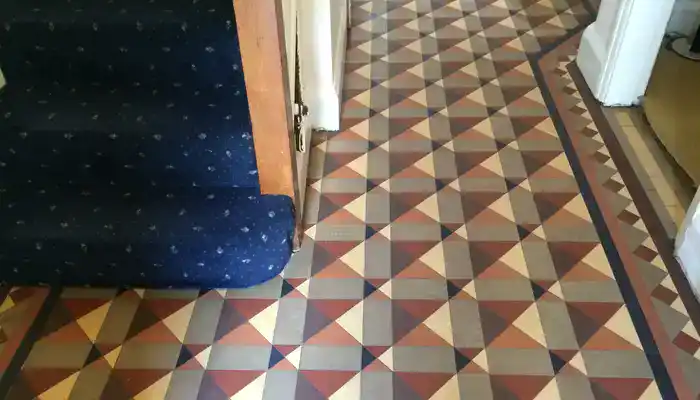
The sight of a heavily soiled, flat Victorian tile floor lacking in original pattern definition indicates deeper issues at play. This was the unfortunate reality for the homeowner in this Stafford ST17 residence, where the hallway failed to reflect the unique character typical of period entrances. Years of persistent foot traffic had gradually dulled the surface, obscuring the intricate decorative pattern that once captivated viewers.
The entrance, which should have made a striking first impression, instead conveyed a sense of weariness and neglect. Large sections displayed uneven colouration; some areas were significantly darker than others, while various border tiles showed clear signs of wear. Although the geometric design remained visible, its impact had been diminished due to the accumulation of grime and general deterioration.
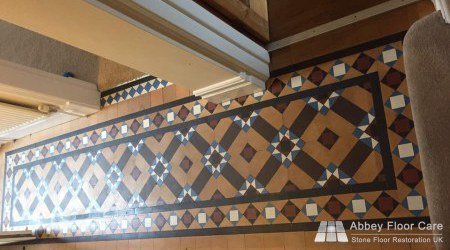
The floor’s overall condition indicated a lack of specialised care for many years. Daily foot traffic had eroded its appearance, dulling the once-vibrant colours and making it challenging to appreciate the intricate layout. Numerous areas showed damage along the edges, while minor chips disrupted what had previously been a crisp and meticulously arranged decorative scheme.
Recognising Visible Signs of Wear Throughout the Hallway
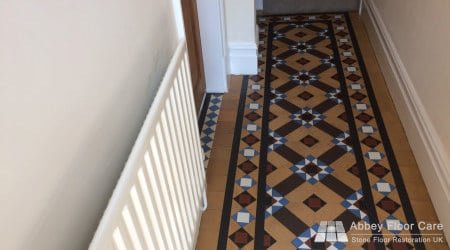
The impact of significant wear from heavy foot traffic was evident along the main walking route. Decades of use created a stark contrast between the most frequently traversed areas and the less-used edges. While the original entrance design remained largely intact, the distinction between colours had faded considerably, resulting in a floor that appeared flatter than when it was first installed.
Specific issues were immediately noticeable. Chipped corners, worn edges, and isolated areas of surface loss distracted from the decorative pattern itself. While it is natural for Victorian floors to show signs of age, the combined effects of wear and contamination began to overshadow their inherent charm.
The homeowner was particularly troubled by the lack of colour definition. Although individual elements within the pattern were still somewhat discernible, they no longer stood out distinctly from one another. What was once a striking visual feature now resembled a largely uniform surface, lacking the vibrancy and clarity it once exuded.
Contemplating the Possibility of Restoration
The porosity of the tiles played a significant role in the overall appearance of the floor, although this issue may not have been immediately apparent during a casual inspection. The unglazed clay had absorbed contaminants over the years, creating the uneven and patchy look that was evident throughout the hallway. For the homeowner, the pressing concern was not just the cause of the problem, but also the potential for meaningful improvement to the floor’s aesthetics.
Considering the floor’s condition, setting realistic expectations proved to be a challenge. Some areas appeared so heavily marked that it was impossible to determine whether the original colour still existed beneath the layers of grime. other sections retained enough visible detail to suggest that significant improvement might still be achievable with the correct restoration approach.
This uncertainty understandably led to hesitation. The homeowner wished to enhance the hallway’s appearance while preserving its period character, yet there were valid concerns that restoration might reveal additional damage or fail to restore enough of the original visual impact.
Before any decisions could be reached, a thorough assessment of the floor in its current state was essential. The aim was not to create a new floor or disguise its age but rather to evaluate whether the original Victorian installation still had sufficient historical fabric and visual integrity to justify a carefully planned restoration programme.
Investigating Why Damage Extended Beyond Surface Dirt, Requiring Comprehensive Assessment
Deep-seated contamination coupled with long-term residue accumulation often creates challenges that seem to be merely surface dirt. An inspection of the Stafford hallway revealed that the visible discolouration was just one aspect of a larger issue. Embedded soiling had accumulated within the porous clay structure, while existing chips and worn areas had become increasingly vulnerable to further deterioration.
Surface dirt was merely one dimension of the issue.
Victorian encaustic and geometric tiles are clay-fired at high temperatures, rendering their surfaces chemically stable but physically susceptible to abrasion and unsuitable for acidic cleaning methods. The survey also revealed inconsistent moisture behaviour within the floor, as well as historic repairs that needed to be considered before any restoration work could begin. Areas where previous floor preparation and localised levelling had altered the surrounding surface required evaluation, alongside the visible wear.
What we often encounter is a combination of issues rather than a single defect. Careful planning was essential because the condition involved contamination, age-related wear, moisture influence, and existing damage, rather than presenting a straightforward cleaning problem.
Implementing a Controlled Restoration Process to Safeguard Original Material
Attempting aggressive repairs on damaged Victorian tiles can result in the loss of irreplaceable original material. For this reason, the restoration process was carried out in a series of controlled phases rather than as a single intensive cleaning operation. Addressing contamination was the first priority, followed by localised repairs and drying periods that facilitated ongoing monitoring of the floor’s condition throughout the entire project.
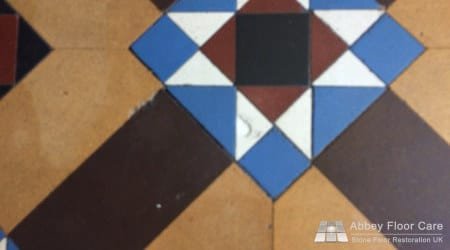
<a href=”https://fabritec.org/victorian-tiles-restoration-for-worn-minton-floors/”>Careful stabilisation</a> focused on preserving as much original material as possible. Damaged areas were repaired without employing abrasive methods that could obliterate surviving historic surface details. The open clay structure was treated using techniques specifically designed to reduce contamination while safeguarding the remaining decorative character of the tiles.
Protective finishing was only applied after the floor had been cleaned, repaired, and allowed to stabilise. Further guidance on conservation-led restoration methods can be found in this guide to restoring Victorian floor tiles safely. A breathable colour-enhancing treatment was chosen to enrich the appearance without forming an artificial surface coating that could detract from the original aesthetic.
Transforming the Hallway into a Cleaner, Richer, and More Cohesive Space While Preserving Its Historical Significance
The most remarkable change following the restoration process was the revival of vibrant colour. Areas that had previously appeared dull and indistinct regained much of their original contrast, allowing the decorative layout to be clearly appreciated once again. The entrance now made a much stronger visual statement while remaining entirely appropriate for a period property.
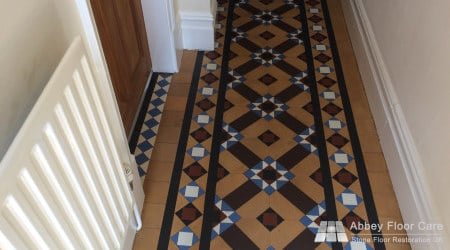
Before restoration, the hallway appeared dark, flat, and visually fragmented by wear and contamination. Decorative details were difficult to discern, and the overall presentation lacked the depth and charm expected in a historical property.
After restoration, the floor exhibited clearer colour definition, enhanced uniformity, and improved visual balance. The revitalised Victorian tile floor revealed the original fired matte surface with consistent colour and pattern, while a topically sealed surface, where appropriate, provided a slight protective sheen without altering its period character. Signs of historic wear remained visible, now contributing to the floor’s authenticity rather than overwhelming its appearance.
Discover More Victorian Tile Restoration Projects and Heritage Floor Recoveries
Anyone facing a similar restoration challenge can often gain valuable insights by reviewing a variety of heritage floor projects before making decisions. The Stafford hallway exemplifies how heavily soiled and visually degraded period flooring can regain considerable character when restoration prioritises retention over replacement.
Additional examples can be explored through projects such as Victorian tile restoration in Nottingham, a hidden hallway floor uncovered in Penkhull, and a Minton tile restoration project in Ovington.
Broader information covering cleaning, restoration, repair, and long-term care is available through the main Victorian and Minton tile cleaning hub. Collectively, these projects illustrate how retaining original material, respecting historic construction, and recovering lost visual character are central to successful Victorian tile restoration.

David Allen — Abbey Floor Care
With over 30 years of experience restoring Victorian tile floors across the UK through Abbey Floor Care, David Allen has undertaken projects in Stafford ST17, Staffordshire. This case study provides a genuine account of a restoration visit where on-site assessment influenced every decision. His approach centres on accurate diagnosis, sympathetic repair, and the preservation of the original character of period flooring.
The Article Victorian Tile Floor Lost Beneath Years Of Neglect first found on https://www.abbeyfloorcare.co.uk
The Article Victorian Tile Floor Hidden Under Years of Neglect appeared first on https://fabritec.org
The Article Victorian Tile Floor Uncovered After Years of Neglect Was Found On https://limitsofstrategy.com